Global online work often depends on seeing platforms the way users see them in different places. For teams that need local visibility, search checks, price comparisons, and ad verification across markets, insocks.com can be approached as a geo targeted proxy platform rather than only a general IP provider. The service presents residential, mobile, static, ISP, and UDP products, along with smart search, proxy history, and detailed IP information, which makes it useful for region based operational tasks. This text focuses on how that location centered model can support daily work in marketing, ecommerce, research, and product testing. ✨
Why regional visibility has become a core business need
Teams no longer work in one market only, even when the company itself is small. Search results, ad placements, product availability, local pricing, and platform behavior can all change from one country or city to another, which means access needs to reflect geography more accurately. A proxy platform becomes more valuable when it helps users recreate those local perspectives with less guesswork.
Local search results are rarely universal
Search engines, stores, and service platforms often personalize or localize what appears on screen. A team checking rankings, offers, or page layouts from one office connection may miss how the same page looks in another country or city. That is why region aware access matters for SEO, ecommerce, and content review work.
Local ad visibility affects campaign judgment
An ad that appears correctly in one market may be missing, displaced, or formatted differently in another. When teams need to verify display behavior across locations, access through geographically relevant IPs becomes part of the validation process. This kind of work is easier when the platform already supports broad country coverage and city level targeting. ✅
Local user experience shapes business decisions
A product page, travel offer, or content block can change according to region, provider logic, or anti personalization controls. If the company wants accurate local insight, it needs a controlled way to observe those versions. A service that emphasizes geo targeted access is therefore more useful than one that offers location only as a secondary feature.
What makes INSOCKS relevant for location based workflows
The service presents itself as a commercial SaaS proxy platform for marketers, developers, SaaS companies, ecommerce businesses, and data teams, with a network spanning 195 countries and city level geo targeting. It also highlights smart search, advanced proxy data, and multiple proxy categories inside one dashboard. For regional testing work, those details matter because the buyer needs selection tools as much as the IPs themselves.
|
Platform feature |
Regional task it supports |
Why it matters |
|
Smart search |
Filtering by suitable proxy characteristics |
Reduces time spent finding market specific IPs |
|
Geo and city targeting |
Local checks by country or city |
Makes results closer to real user views |
|
Residential proxies |
Local browsing and content verification |
Useful for natural looking regional sessions |
|
Mobile proxies |
Mobile first platform review |
Strong fit for social and mobile ad checks |
|
Proxy history |
Repeating the same regional workflow later |
Supports consistent review over time |
|
Demo access |
Testing a market before scaling |
Cuts risk in new regional campaigns |
Search tools help narrow the regional task faster
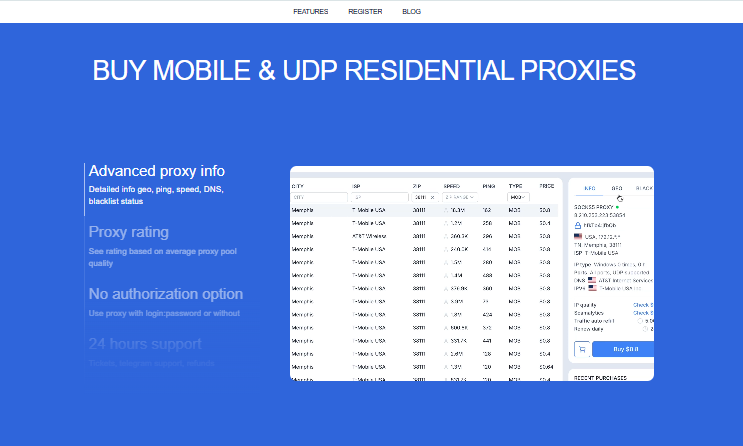
A long country list is not enough on its own. The platform highlights smart search and detailed proxy information such as geo, ping, speed, DNS, and blacklist status, which means users can compare location options with more context before activation. That is especially useful when a market check depends on both geography and connection quality.
One dashboard reduces market testing friction
The site states that residential, mobile, ISP, static, and UDP products are available under one environment. For a team that checks several markets and several channel types, one dashboard can reduce operational friction compared with switching between specialized vendors. A unified environment also makes review and repeatability easier. ✨
Comparing proxy types for market visibility work
Not every regional task should use the same proxy category. The wrong type can make a workflow slower, less realistic, or less stable than it needs to be. Comparison is important because market visibility work often includes several job types inside one campaign.
Residential proxies for natural local viewing
The site describes residential proxies as real household ISP addresses suited to web scraping, SEO tracking, price monitoring, and content verification across 195 countries. For regional browsing tasks, this makes them a practical first option when the goal is to see the web from a more consumer like perspective. They are often the most intuitive fit for local observation work.
Mobile proxies for mobile first checks
INSOCKS describes its mobile proxies as routed through real 4G and 5G carrier networks and positions them for social media automation and ad verification. That makes them relevant when a team needs to review how campaigns or interfaces behave in mobile centered environments. If the workflow depends on mobile network realism, this type deserves priority. ✅
Which proxy type fits which regional task
Regional operations rarely depend on one pattern only. A company may need local search checks, local ad validation, repeated dashboard access, and faster high volume collection in the same week. Using one proxy category for every task usually creates unnecessary tradeoffs.
|
Proxy type |
Best regional use |
Main strength for that use |
|
Residential |
Search checks and local content viewing |
Natural browsing context |
|
Mobile |
Social and mobile ad review |
Carrier based traffic profile |
|
Static |
Repeat checks from one known location |
Stable identity over time |
|
ISP |
Faster recurring regional operations |
Speed with cleaner appearance |
|
UDP |
Live regional application testing |
Support for real time traffic |
Best choice for SEO and search visibility teams
The service explicitly mentions SEO tracking and search performance as supported workflows. For ranking checks across locations, residential proxies are often the most practical default because they align well with local viewing tasks and geo targeted access. When the check needs to be repeated from the same location, static or ISP options may also become useful.
Best choice for ad monitoring teams
INSOCKS names ad monitoring as a direct use case and describes mobile proxies as strong for ad verification. That suggests a two layer approach for many teams: residential IPs for general local ad viewing and mobile IPs for mobile first campaign checks. The right split depends on whether the campaign is browser centered or heavily mobile in behavior.
Best choice for ecommerce and travel comparison work
The homepage points to ecommerce, travel connectivity, and price monitoring as practical uses. Those teams usually benefit first from region precise access, then from stable repetition. For quick spot checks residential can be effective, while static or ISP options may fit ongoing comparison workflows better. ✨
Practical recommendations for teams planning regional checks
A market visibility workflow works best when the task is defined before the proxy is chosen. Teams that skip this step often buy access first and only then try to decide what the IP should actually do. A better sequence keeps the process cleaner and more cost effective.
Start with the question not the proxy
Write down exactly what needs to be seen. The job may be local rankings, ad appearance, store pricing, app behavior, or repeated platform monitoring. Once the question is clear, the proxy type and region become easier to assign.
Match the region to the business goal
If the goal is national coverage, country level targeting may be enough. If the goal is city level comparison or closer local simulation, then more precise targeting becomes important. The site states that INSOCKS supports 195 countries and city level geo targeting, which makes this step more practical than with a provider that offers only broad regional buckets.
Use demo access before broader rollout
The platform offers demo proxies and describes them as a way to test speed, IP quality, rotation behavior, and authentication compatibility before moving to production workloads. For regional work, that means a team can validate whether a location and proxy type actually fit the campaign before expanding spend. This is one of the strongest habits for reducing wasted budget. ✅
Informational block for common regional workflows
Some teams still treat geo targeted proxies as a narrow SEO tool, but the site itself points to a wider range of uses. These include AI data supply, crawling infrastructure, social media outreach, travel connectivity, ad monitoring, and search performance. That list shows how location and network identity now affect many operational functions at once.
For agencies handling many client markets
Agencies often need one dashboard where several regions and several proxy types can be managed without switching providers. A platform that combines location coverage with multiple product families reduces coordination overhead. That becomes especially useful when different clients need different regional checks during the same reporting cycle.
For internal product and QA teams
Product teams may need to observe how a service behaves across places, devices, and traffic types. With residential, mobile, ISP, static, and UDP options listed together, the platform can support broader validation logic than a single format provider. That helps QA teams treat geography as part of testing instead of as an afterthought.
Strengths and watch points in location centered use
No proxy platform becomes effective just because it offers many countries. What matters is how well the service helps teams convert geographic access into reliable workflows. INSOCKS shows several strengths in that direction, but it still works best when the user is disciplined about task matching.
Visible strengths for region based work
-
✅ Coverage across 195 countries and city level targeting support local observation tasks.
-
✅ Several proxy categories can be matched to different regional jobs in one account.
-
✅ Demo access helps validate location fit before scaling.
-
✅ Proxy history supports repeated checks and internal review.
-
✅ Smart search and detailed IP data make selection more deliberate.
Watch points teams should keep in mind
-
❌ One proxy type should not be forced onto every regional workflow.
-
❌ Country access alone may be too broad when the task is truly city specific.
-
❌ Fast onboarding can tempt teams to scale before they validate the local setup.
-
❌ Repetition without reviewing history may weaken the quality of the process. ✅
Where this platform creates the most value
The service becomes strongest when a company needs to see markets, not merely reach them. That difference matters because market visibility work depends on repeatability, regional fit, and the right proxy type for the right question. A platform with broad location coverage and several proxy models becomes more useful when it is treated as part of ongoing local analysis.
Best fit for teams that think in regions
A business that checks several countries, several campaigns, or several local content versions will usually gain more from this kind of platform than a user who only wants one generic IP. The product mix, geo targeting, demo testing, and usage history all support that style of work. For region centered operations, those features work together rather than standing apart. ✨
Better results come from structured local routines
The strongest practical habit is simple. Define the local question, choose the proxy type that matches it, test on a small scale, then repeat the process only after validation. When teams work that way, the platform becomes more than a vendor page and starts functioning as a dependable part of market visibility operations.